
The waste crisis in the Himalayas is not simply a problem of litter; it is a systemic challenge driven by gaps in infrastructure, governance, community practices, and economic incentives. Our Theory of Change articulates five interconnected outcomes that, together, enable the systems change required to achieve lasting impact. For each outcome, it sets out the core interventions that drive change, alongside the key assumptions underpinning our approach.

Theory of Change

Impact: The Himalayas thrive as a climate-resilient ecosystem - safeguarding the future for people and nature.

Stronger Ownership & Accountability
  • Healers volunteer movement
  • Community dialogues & user fee systems
  • Awareness & behaviour change campaigns
  • Regenerative travel
Enhanced Infrastructure Coverage
  • Cluster level MRF
  • Right sized transport & collection
  • Waste conscious local development planning
  • Mountain-adapted recycling & upcycling
Expanded Climate-Smart Livelihoods
  • Train & certify local youth & women
  • Self Help Group (SHG) workshops & innovation grants
  • Green Livelihood Learning Hubs
  • Sustainable tourism practices
Improved Policies & Governance
  • Deposit Refund Scheme (DRS) pilots
  • Green tourism policies
  • Decentralised, mountain-appropriate waste systems
  • Digitise EPR enforcement
INCREASED INNOVATION & EVIDENCE
  • Data-driven planning & impact measurement
  • In-house R&D and Innovation Unit
  • Healing Himalayas Knowledge Hub
  • HH! a global voice for high altitude circular waste management
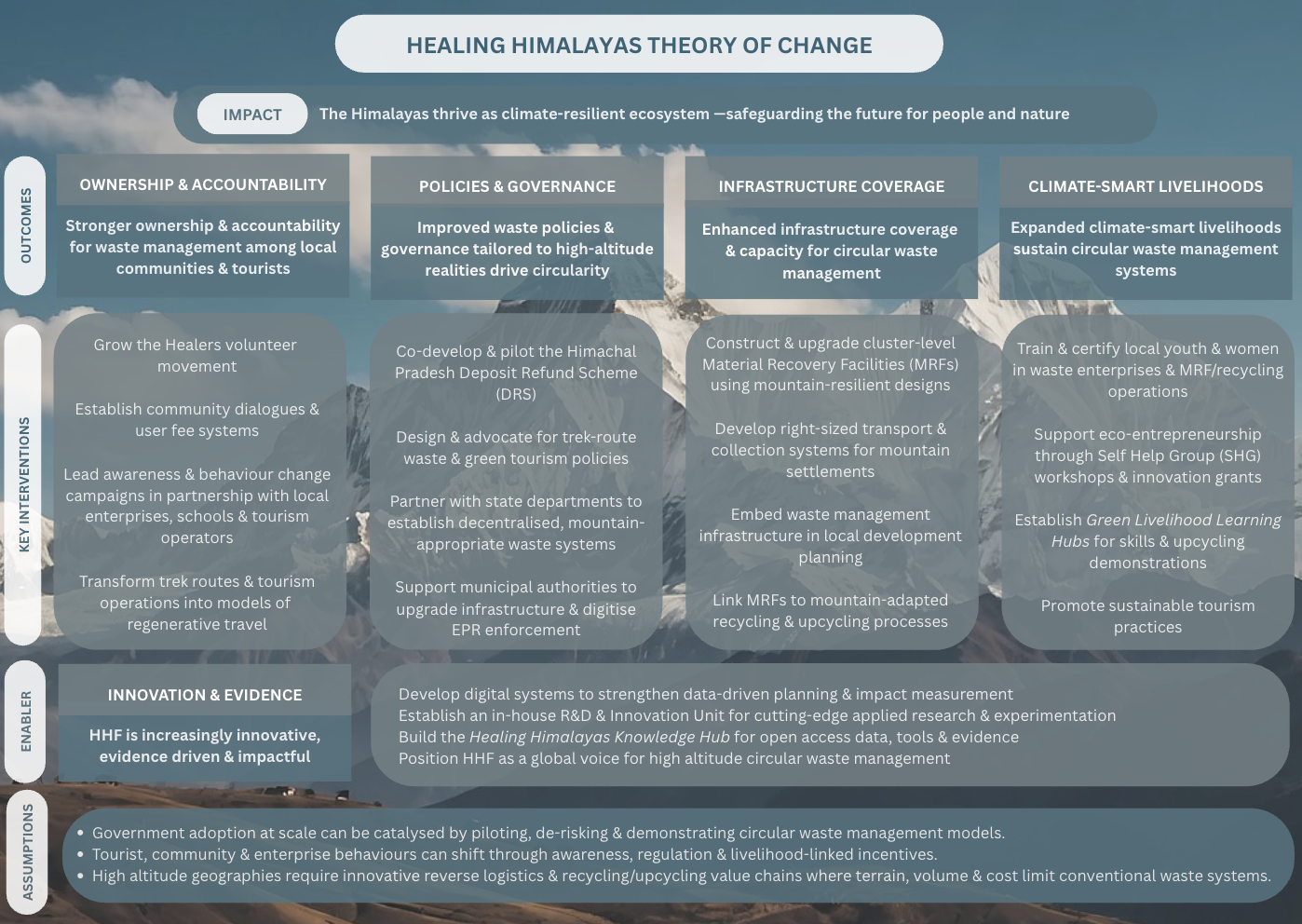
Assumptions:
  • Government adoption at scale can be catalysed by piloting, de-risking & demonstrating circular waste management models.
  • Tourist, community & enterprise behaviours can shift through awareness, regulation & livelihood-linked incentives.
  • High altitude geographies require innovative reverse logistics & recycling/upcycling value chains where terrain, volume & cost limit conventional waste systems.
Theory of Change Diagram
×